// Devcon field notes
Devcon 8 Mumbai — Day 1: Building a More Resilient Ethereum, One Network at a Time
· Mumbai, India
Devcon 8 in Mumbai brought together builders, researchers, protocol developers, security practitioners, and open-source communities from across the world. For us, Day 1 marked the beginning of an important conversation about the foundations of decentralized infrastructure: how do we build networks that remain open, secure, private, and resilient in an increasingly unpredictable digital world?
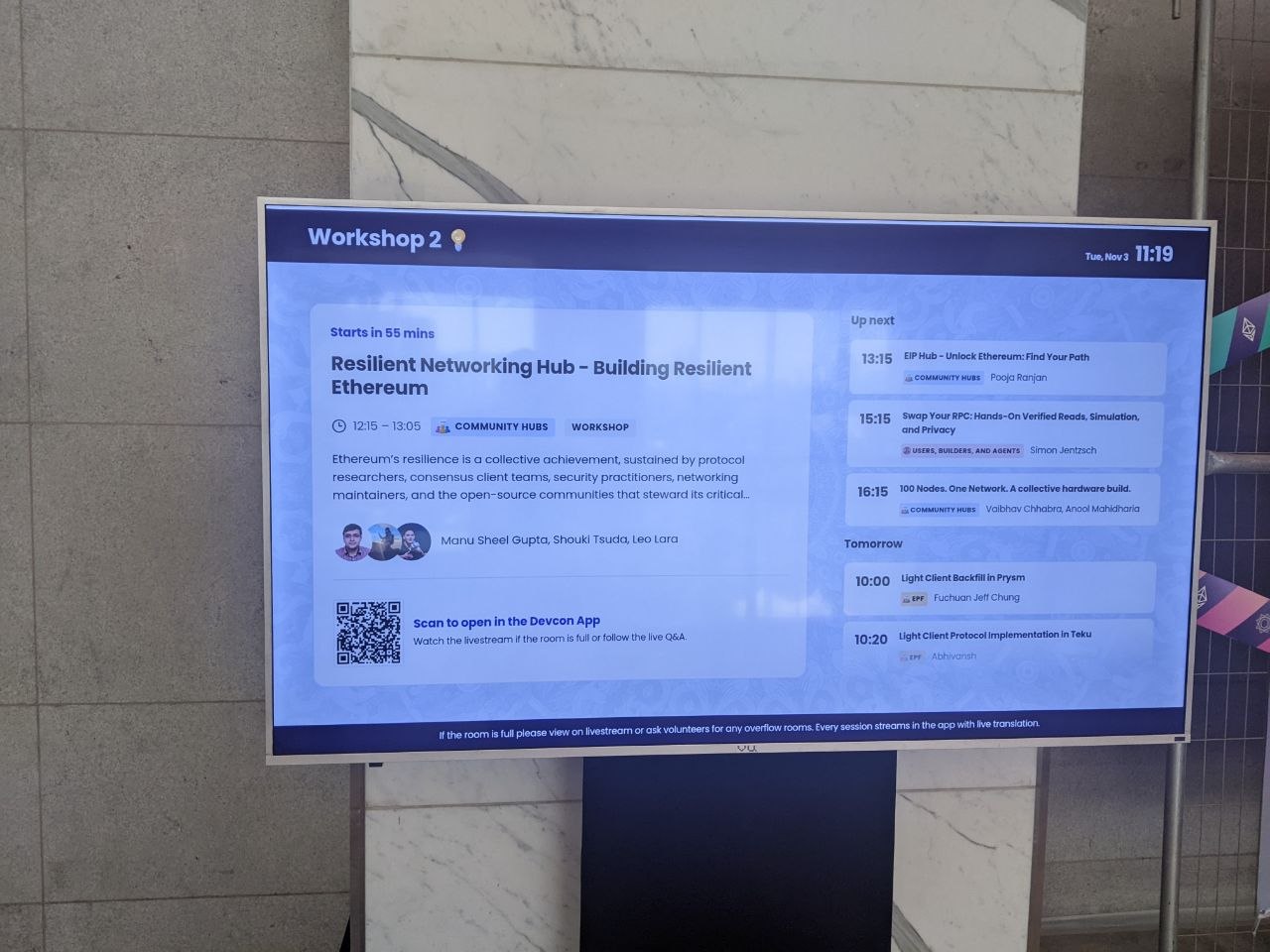
We kicked off the day at the Resilient Networking Hub, with our opening on-stage workshop, Building Resilient Ethereum: Networking, PQ Security & Verified Consensus.
Hosted as part of the libp2p Expedition Mumbai, the session established the central themes of our four-day Resilient Networking Hub programme: resilient connectivity, privacy-preserving infrastructure, post-quantum security, verifiable systems, and sustainable protocol maintenance.
The conversation brought together contributors working across Ethereum networking, libp2p, formal verification, privacy, and decentralized infrastructure.
1. Opening the Resilient Networking Hub: Building Resilient Ethereum
Our opening session explored a fundamental question:
How can we build permissionless networks that survive disconnection, resist censorship, protect privacy, and remain secure against emerging threats?
Ethereum's resilience depends on much more than its consensus mechanism. It also depends on the underlying networking infrastructure that connects participants, propagates messages, enables discovery, and keeps distributed systems functioning under adverse conditions.
We explored several interconnected areas:
- libp2p as a shared networking substrate: Understanding its role across Ethereum consensus clients and the broader decentralized ecosystem.
- Post-quantum security: Exploring initiatives by libp2p maintainers, including hybrid ML-KEM key exchange and quantum-resistant peer identities.
- Privacy-preserving observability: Developing ways to measure network health, identify systemic risks, and improve reliability without compromising privacy or credible neutrality.
- Formal verification and protocol correctness: Examining the work of invisible.garden and its etheorem initiative, building a consensus implementation in Lean 4.
- Evidence-based security: Connecting mechanically checked correctness, interoperability, protocol security, and more accountable infrastructure maintenance.
The session set the tone for the days ahead: resilient infrastructure must be designed not only to function under ideal conditions, but also to withstand failures, adversarial environments, censorship, and technological transitions.
2. From Verifiable Actions to Private Coordination
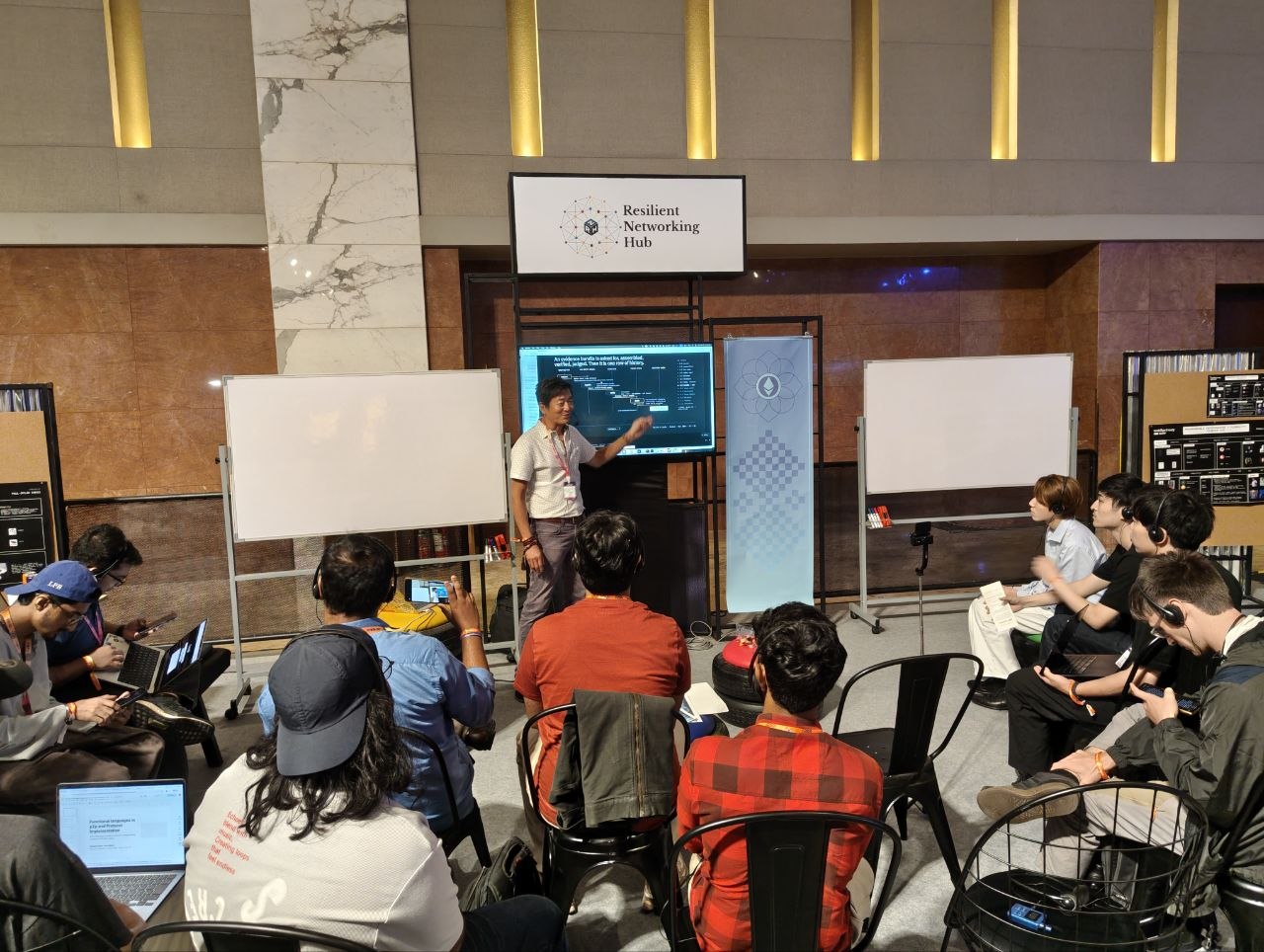
The morning programme continued with discussions on verifiable actions in open systems.
Steven Mih, Anurag, and Manu explored why independently verifiable evidence matters when participants, infrastructure, and computational resources cannot automatically be trusted.
We then heard from Kazuma Sengoku, who presented:
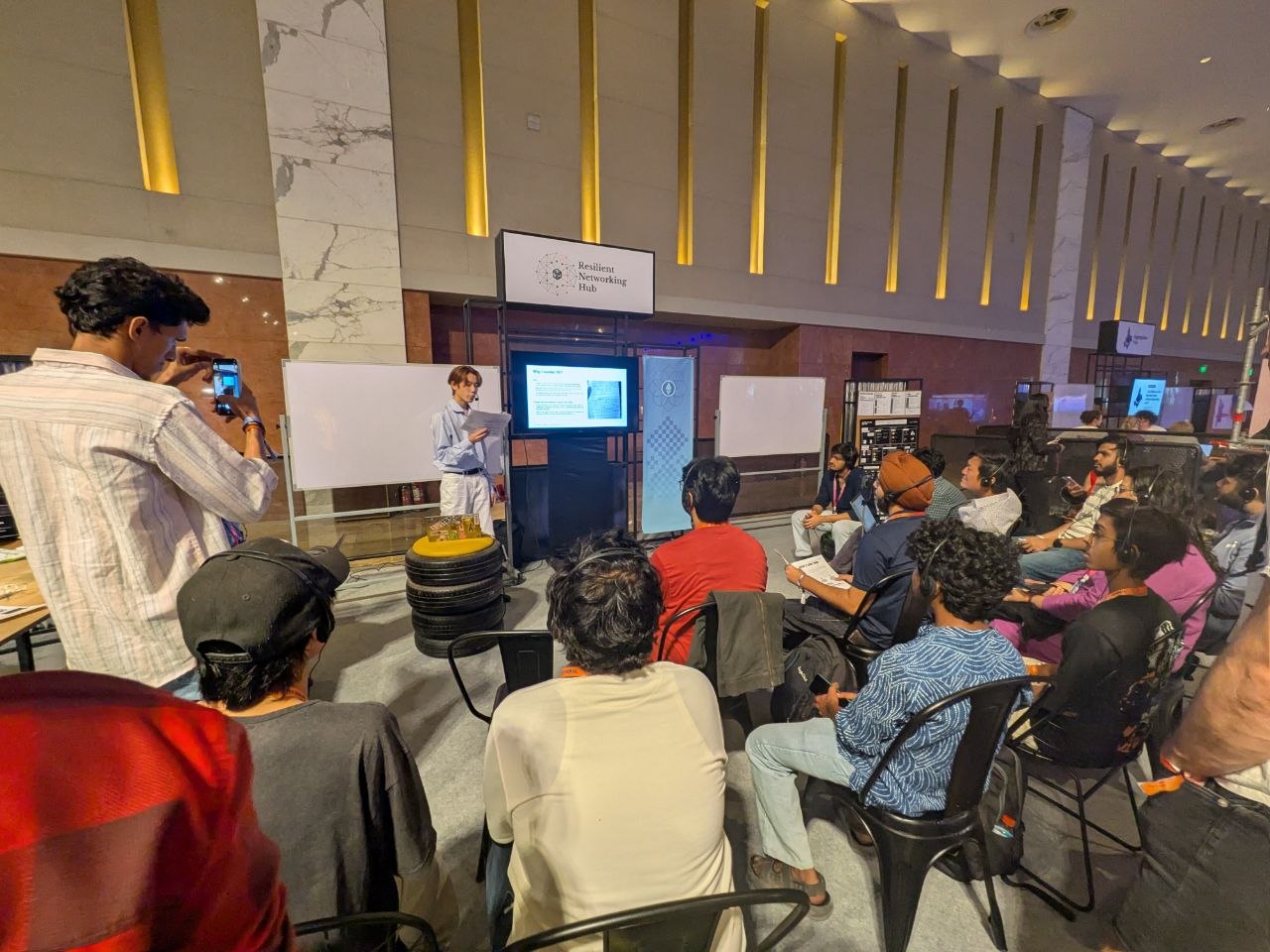
A key you own. A membership proof that does not say who. A shared clock.
The discussion examined three important building blocks for private and resilient coordination:
- Individual ownership and control of cryptographic keys.
- Membership proofs that preserve privacy without unnecessarily revealing identity.
- Shared notions of time that enable coordination across distributed participants.
These ideas are particularly relevant to decentralized systems where trust must emerge from verifiable properties rather than centralized identities or intermediaries.
3. Maintainer Meet-up and Network Lab: Connecting Builders
One of the defining aspects of the Resilient Networking Hub was its emphasis on bringing maintainers and builders together.
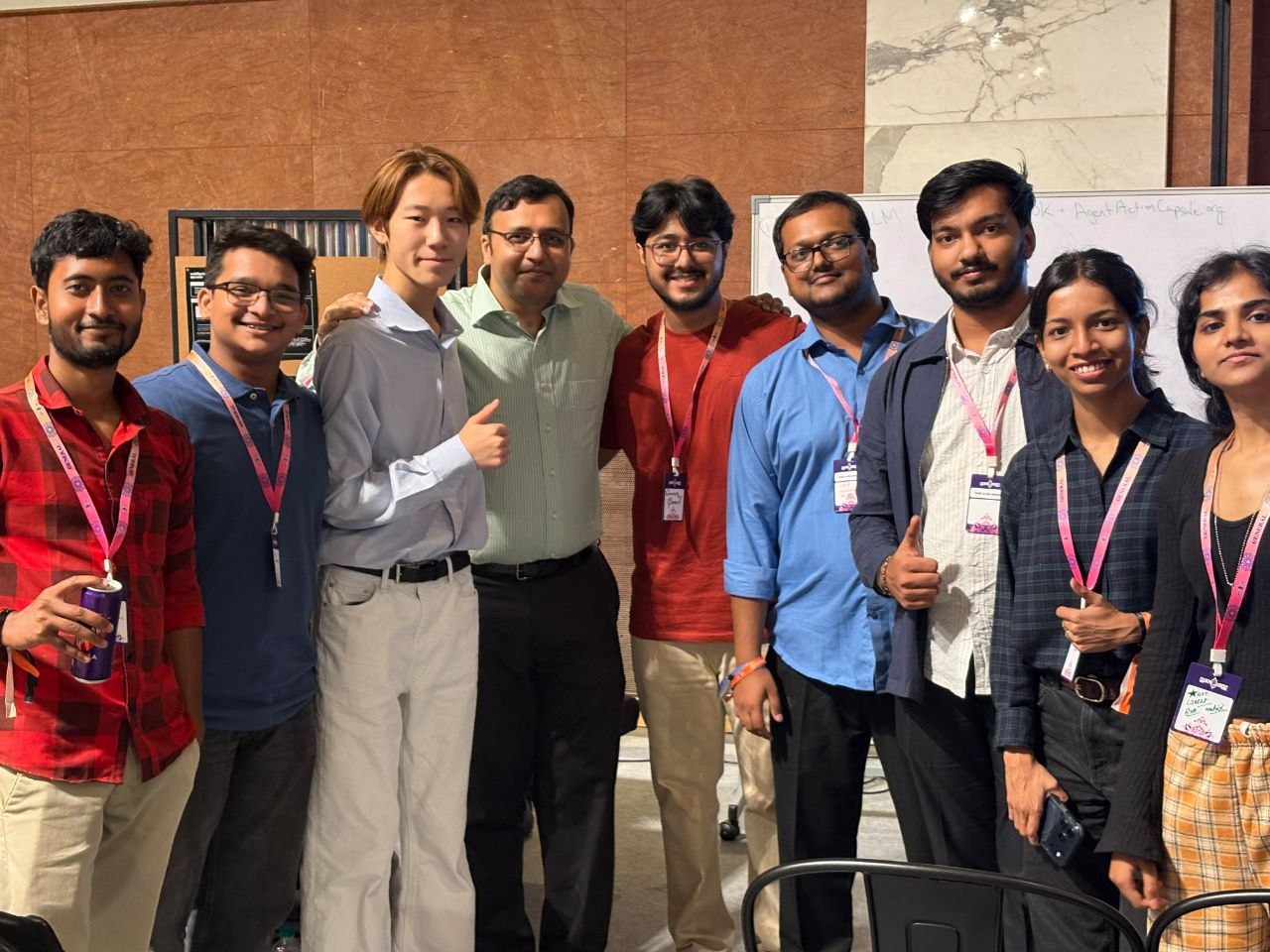
Our maintainer meet-up and Network Lab 101 created an opportunity for participants to introduce their projects, exchange ideas, and engage directly with the people maintaining critical networking infrastructure.
Daniel Thompson, Shouki Tsuda, Sumanjeet, Soham Bhoir, and Yash Saini joined the discussion.
Rather than treating networking as an abstract protocol-layer problem, we wanted to create a practical environment where contributors could identify interoperability challenges, discuss research questions, and explore opportunities for collaborative experimentation.
The subsequent roundtable, What Makes a Network Resilient?, brought together Miglė Rakitaitė, representatives from the Ethereum Swarm leadership, Manu Sheel Gupta, Steven Mih, and Thomas Humphreys.
The discussion examined four interconnected dimensions:
- Connectivity — maintaining communication across heterogeneous and unreliable networks.
- Trust — establishing verifiable relationships without unnecessary centralization.
- Failure — understanding how distributed systems behave under unexpected conditions.
- Recovery — designing infrastructure that can adapt and continue operating after disruption.
These discussions helped establish a shared research agenda for the Resilient Networking Hub.
4. Formal Verification for Decentralized Systems
The afternoon programme moved into the practical foundations of protocol correctness.
Banri Yanahama and Ryosuke Kaga led:
Formal Verification for Decentralized Systems: Practical Approaches to Reasoning About Protocol Correctness.
The workshop explored how formal methods can help developers reason about decentralized protocols, identify potential correctness issues, and establish stronger guarantees about system behaviour.
The work of invisible.garden and its etheorem initiative provided an important context for the broader conversation: bringing mechanically checked reasoning into the implementation and verification of consensus systems.
As decentralized infrastructure becomes increasingly interconnected, correctness is not simply a matter of passing tests. It is also about developing stronger, independently verifiable confidence in the systems on which the ecosystem depends.
5. Evidence for AI Inference From Strangers: Mesh-LLM
We also explored the intersection of decentralized networking, AI infrastructure, and verifiable computation.
Steven Mih, Manu, and Anurag presented:
Evidence for AI Inference From Strangers: The Design Behind Mesh-LLM's Capsules Plugin.
The session examined how evidence can be produced when AI inference takes place on machines operated by independent participants.
This raises important questions for agent-native infrastructure:
- How can users establish confidence in computations performed by unknown operators?
- What evidence should accompany an inference result?
- How can decentralized systems coordinate computation without requiring centralized trust?
- How can cryptographic proofs and verifiable execution contribute to accountable AI infrastructure?
These questions connect directly with the broader vision of resilient, permissionless networks: infrastructure that enables independent participants to collaborate while retaining the ability to verify what happened.
6. Functional Languages and Interoperability Across P2P Stacks
Shouki Tsuda continued the technical programme with:
Functional Languages in P2P and Protocol Implementation: Implementation Choices and Interoperability Across P2P Stacks.
The discussion considered how programming language choices influence protocol implementations, maintainability, and interoperability across different peer-to-peer networking stacks.
As libp2p continues to support implementations across multiple programming languages and ecosystems, interoperability becomes essential.
Different implementations must be able to communicate reliably, preserve protocol semantics, and evolve without fragmenting the wider network.
7. Building and Sustaining Self-Hosted IPFS Infrastructure
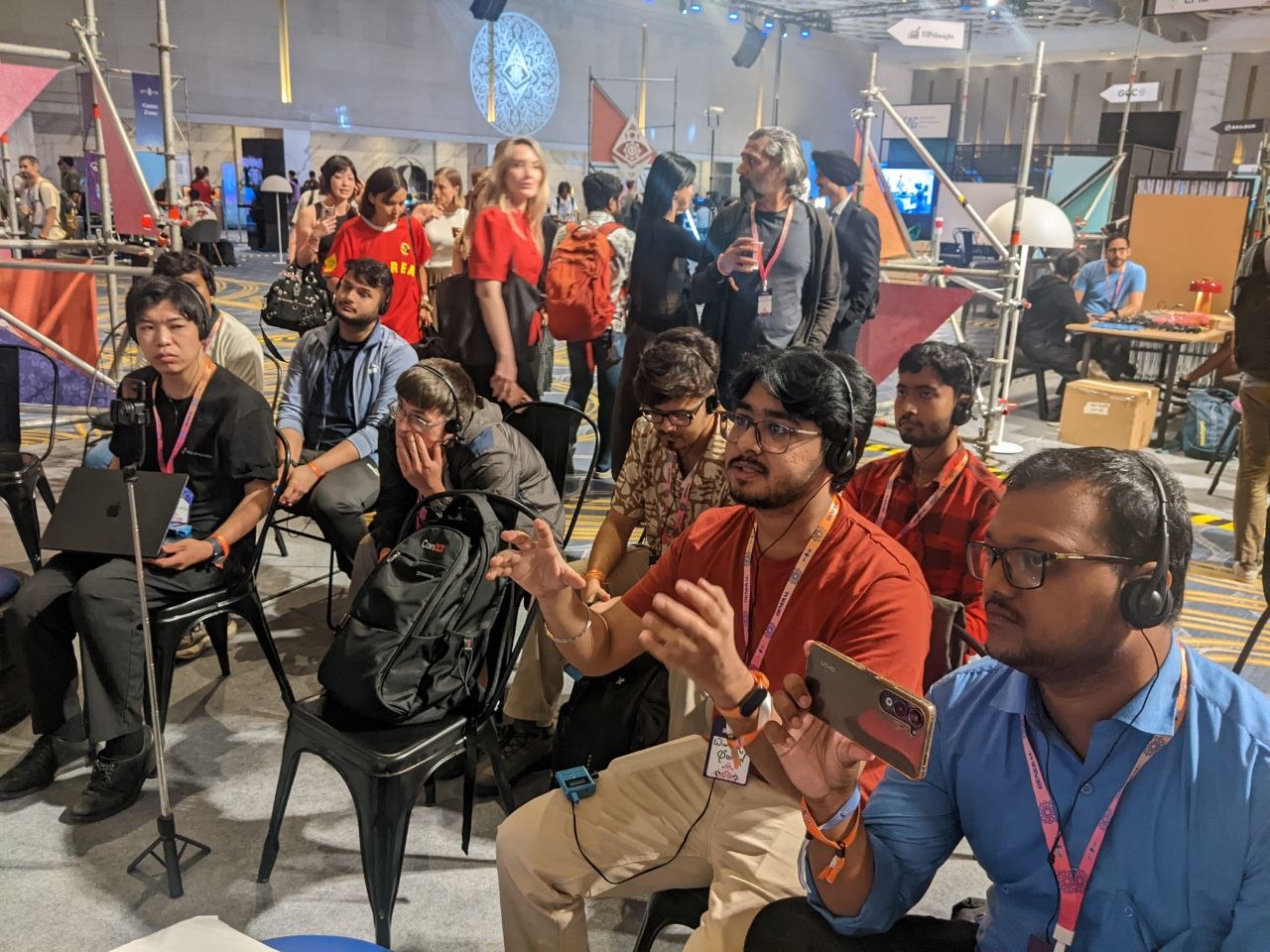
We concluded the afternoon with a practical workshop led by Anurag Pandey and Manu Sheel Gupta:
Building and Sustaining Self-Hosted IPFS Infrastructure: Operations, Maintenance and Accessibility.
The session focused on the practical realities of running self-hosted IPFS infrastructure, including:
- Infrastructure setup and operational considerations.
- Day-to-day maintenance and reliability.
- Accessibility and availability of content.
- Building sustainable decentralized storage infrastructure.
For decentralized applications, content-addressed storage and peer-to-peer networking are complementary foundations. However, adoption requires more than deploying technology: infrastructure must remain accessible, maintainable, and understandable to the people operating it.
The day concluded with another Maintainer Meet-up and Network Lab session, bringing together Sumanjeet, Daniel Thompson, Yash Saini, and Soham Bhoir for collaborative discussions around research questions and practical experiments.
8. The Bigger Picture: Connecting Networking, Security, Verification and AI
Day 1 demonstrated why resilient networking is a multidisciplinary challenge.
The discussions connected several areas that are often considered independently:
- libp2p and peer-to-peer networking.
- Ethereum consensus and protocol security.
- Post-quantum cryptography.
- Privacy-preserving network observability.
- Formal verification and mechanically checked correctness.
- Verifiable AI inference and agent-native infrastructure.
- IPFS and sustainable decentralized storage.
Together, these areas point towards a more robust vision for decentralized infrastructure: networks that are not only permissionless, but also observable, verifiable, privacy-preserving, interoperable, and capable of adapting to emerging threats.
For the Resilient Networking Hub, the first day was about establishing the foundations, bringing communities together, and identifying the engineering and research opportunities that will shape the next generation of decentralized systems.
The journey had only just begun.
About the Resilient Networking Hub
The Resilient Networking Hub was part of the libp2p Expedition Mumbai, a nine-day journey through Mumbai's decentralized technology ecosystem, running from October 31 to November 8, 2026.
The four-day Resilient Networking Hub programme at Devcon 8, November 3–6, brought together protocol maintainers, researchers, developers, and ecosystem contributors to advance resilient networking, privacy, security, interoperability, and decentralized infrastructure.
Explore the programme:
Explore the programme
Explore the Day 1 Devcon schedule:
https://app.devcon.org/schedule/resilient-networking-hub-building-resilient-ethereum
Build resilient networks. Strengthen decentralized infrastructure. Keep the network open.