
// Privacy & security
Ethereum Cypherpunk Congress #3: Is Your Privacy Actually Private? libp2p Explores LeakDetectAI, Post-Quantum Security and Verified Networking
· Mumbai, India
From measuring hidden information leaks in Ethereum wallets and AI agents to building quantum-resistant networking and formally verifiable protocols, libp2p's participation at Ethereum Cypherpunk Congress #3 in Mumbai highlighted the engineering challenges behind a more private, resilient and trustworthy decentralized web.
On November 2, 2026, the Ethereum Cypherpunk Congress #3 brought together privacy researchers, cryptographers, open-source developers, protocol engineers and members of the Ethereum ecosystem in Mumbai, ahead of Devcon 8.
With its theme, The Ancestral Fork, the Congress explored the intersection of privacy, cryptography, digital rights, censorship resistance, decentralized infrastructure and the future of open-source technology.
libp2p participated with its maintainers and community members, contributing to conversations around privacy-preserving infrastructure, resilient networking, cryptographic security and the future of decentralized systems.
A key highlight was a presentation by Manu Sheel Gupta (@manusheel), introducing LeakDetectAI and examining a question that deserves greater attention across the Ethereum ecosystem:
Your wallet still leaks data. Your AI agent exposes your intent. Your network reveals your identity. Is your privacy actually private?
The presentation connected practical side-channel analysis with the broader cypherpunk vision: privacy should not simply be promised by applications and protocols. It should be measurable, testable and continuously improved.
The discussions also connected three complementary libp2p initiatives:
-
LeakDetectAI: Detecting and eliminating hidden information leaks in Ethereum wallets, AI agents and cryptographic systems.
-
An Incremental Path to Quantum-Resistant Ethereum: Preparing Ethereum's peer-to-peer networking infrastructure for post-quantum cryptography.
-
Leanp2p: Bringing libp2p to Lean 4 and exploring formally verified networking for Ethereum.
Together, these initiatives demonstrate how privacy, cryptographic resilience and protocol correctness can contribute to a stronger decentralized ecosystem.
1. LeakDetectAI: Is Your Privacy Actually Private?
At the Congress, Manu Sheel Gupta presented LeakDetectAI, focusing on the often-overlooked problem of information leakage through side channels.
Encryption and cryptographic protections are essential foundations of decentralized applications. However, protecting the contents of a communication or transaction does not necessarily prevent an adversary from learning sensitive information through observable system behaviour.
Even when private keys, transaction details and sensitive inputs are never directly exposed, an attacker may be able to infer information from:
-
Execution timing and computational patterns.
-
Memory and resource consumption.
-
Cryptographic operation behaviour.
-
Hardware-wallet interactions.
-
AI-agent execution and authorization workflows.
-
Observable network and application activity.
These are examples of side-channel information leakage.
The challenge is particularly relevant as Ethereum applications increasingly integrate hardware wallets, autonomous agents, cryptographic protocols and complex distributed infrastructure.
From theoretical privacy to measurable leakage
LeakDetectAI aims to make hidden information leakage observable through reproducible experiments, automated quantitative analysis and machine-learning-assisted detection.
The initiative builds on research and open-source tooling associated with AutoSCA and automated side-channel analysis.
Its technical foundation includes:
-
Deep-learning-based side-channel analysis.
-
Automated quantitative information-leakage detection.
-
Hardware-wallet testing and evaluation.
-
Machine-learning and neural architecture search pipelines.
-
Reproducible adversarial experiments and security benchmarks.
The objective is to move beyond simply identifying that a system might leak information. LeakDetectAI aims to measure leakage, validate potential vulnerabilities and help developers translate research findings into actionable security improvements.
Project resources:
Bringing LeakDetectAI into Ethereum workflows
An important direction for the initiative is integrating side-channel security testing into actual Ethereum development and deployment environments.
Six adoption areas are prioritised:
1. Wallet and hardware-wallet security
Testing desktop, mobile and hardware wallets across representative Ethereum key-management, signing and authorization workflows.
Prospective targets include MetaMask, Rabby Wallet, Trust Wallet and Safe.
2. Existing Ethereum field deployments
Applying LeakDetectAI in existing field-testing contexts, including Ledger hardware-wallet workflows and the Diagnosity health-AI deployment environment.
3. Ethereum Layer 1 and Layer 2 ecosystems
Extending security testing across Ethereum and Layer 2 environments, including Optimism, Arbitrum and Base.
4. Ethereum agents and protocol security
Evaluating side-channel risks in agent execution, transaction authorization and protocol-integrated workflows, including relevant contexts around Agent0 (ERC-8004), Aave and Morpho.
5. AI-agent framework security
Engaging developers to evaluate cryptographic operations, transaction execution and authorization workflows, with prospective targets including Coinbase AgentKit and ElizaOS.
6. Ecosystem-wide remediation
Turning findings into actionable remediation efforts, upstream patches, regression tests and publicly verifiable security improvements.
These organisations and projects represent prospective adoption targets and existing technical or ecosystem contexts, rather than guaranteed partnerships or adoption commitments.
From discovery to remediation
The longer-term objective is to establish a repeatable security improvement cycle:
Discover → Measure → Validate → Remediate → Regression-test
The value of side-channel research ultimately comes from its ability to improve real systems. This means working with wallet developers, protocol maintainers and AI-agent framework developers to translate experimentally validated findings into practical security improvements.
Explore and support the initiative:
LeakDetect: Protecting Ethereum from Hidden Leakages — Giveth
Watch the Congress highlight: Manu Gupta from libp2p on measuring hidden privacy leaks with LeakDetect
2. An Incremental Path to Quantum-Resistant Ethereum
The future of decentralized infrastructure also depends on preparing for changes in cryptographic security.
Post-quantum cryptography was another important subject in the broader conversations at Ethereum Cypherpunk Congress #3.
In a highlighted discussion, @Zac_Aztec of Aztec and @jbaylina of ZisK explored why post-quantum cryptography needs a practical reality check and why the ecosystem must distinguish a credible security roadmap from sensational headlines.
For Ethereum, quantum readiness cannot be limited to account signatures and validator cryptography.
The networking infrastructure connecting Ethereum nodes also needs a transition strategy.
This includes peer discovery, authentication, secure session establishment, message propagation and light-client connectivity.
Bringing post-quantum capabilities to the networking layer
The libp2p initiative, An Incremental Path to Quantum-Resistant Ethereum, focuses on developing and integrating opt-in post-quantum security capabilities into Ethereum's peer-to-peer networking stack.
Its priorities include:
-
Hybrid post-quantum key exchange: Exploring combinations of established classical cryptography and post-quantum mechanisms.
-
Quantum-resistant peer identities: Investigating how peer authentication and identity mechanisms can evolve.
-
Post-quantum node discovery: Evaluating the implications of quantum-resistant cryptography for discovering and authenticating peers.
-
Secure light-client connectivity: Extending post-quantum security considerations to infrastructure serving Ethereum light clients.
Why an incremental transition matters
Ethereum cannot simply replace its networking infrastructure overnight.
A practical transition requires experimentation, compatibility testing, performance evaluation and coordination across independently developed client implementations.
The objective is to enable Ethereum client teams to evaluate, integrate and progressively adopt post-quantum networking capabilities without requiring an immediate network-wide migration.
This is particularly important because post-quantum cryptography introduces engineering considerations around larger keys and signatures, handshake overhead, bandwidth consumption and compatibility.
The goal is to make the transition measurable, interoperable and actionable before it becomes an emergency.
Explore: An Incremental Path to Quantum-Resistant Ethereum
3. Leanp2p: Bringing Formally Verified Networking to Ethereum
Another important dimension of resilient decentralized infrastructure is protocol correctness.
What if networking protocols could be described as executable specifications and important properties could be checked mathematically?
This is the ambition behind Leanp2p, a community-developed initiative bringing libp2p to Lean 4.
The initiative was shared on stage at the Resilient Networking Hub during the Devcon 8 workshop, Building Resilient Ethereum.
Executable, machine-checked networking specifications
Leanp2p begins with Ethereum consensus-layer networking and explores how formal methods can complement conventional protocol implementation and testing.
Distributed networking protocols involve complex state transitions, message exchanges, peer discovery, authentication and connection management.
Even when implementations pass conventional tests, subtle discrepancies between specifications and actual protocol behaviour can introduce vulnerabilities.
Leanp2p explores a complementary approach using Lean 4 to express protocol properties in a form that can be machine-checked.
Its technical focus includes:
-
Formal methods and theorem proving.
-
Executable protocol specifications.
-
Interoperability testing.
-
Machine-checked networking invariants.
-
Security-oriented protocol engineering.
The longer-term ambition is verified networking: stronger guarantees around protocol behaviour, more confidence in state transitions and a more reliable foundation for protocol evolution.
Leanp2p does not replace existing Ethereum consensus clients. Instead, it provides a complementary foundation against which their protocol behaviour can be checked and improved.
Explore: Verified Networking for Ethereum
4. Three Initiatives, One Vision for Decentralized Infrastructure
Although LeakDetectAI, post-quantum Ethereum networking and Leanp2p address different technical challenges, they share a common objective: strengthening the foundations of decentralized infrastructure.
-
LeakDetectAI — Hidden information leakage. Intended outcome: measurable and remediated privacy vulnerabilities.
-
Quantum-Resistant Ethereum — Future cryptographic threats. Intended outcome: incremental post-quantum networking adoption.
-
Leanp2p — Protocol correctness and interoperability. Intended outcome: machine-checked networking specifications.
These initiatives address three complementary questions:
Privacy: Can supposedly private systems unintentionally reveal sensitive information through their observable behaviour?
Cryptographic resilience: Can Ethereum's networking infrastructure adapt as cryptographic assumptions evolve?
Protocol correctness: Can we establish stronger confidence in the behaviour of the protocols connecting distributed participants?
The answers require more than theoretical research. They require open-source implementations, reproducible experiments, interoperability testing, maintainer collaboration and practical adoption.
This is where the libp2p community plays an important role.
5. The Cypherpunk Vision: Privacy, Resilience and Digital Freedom
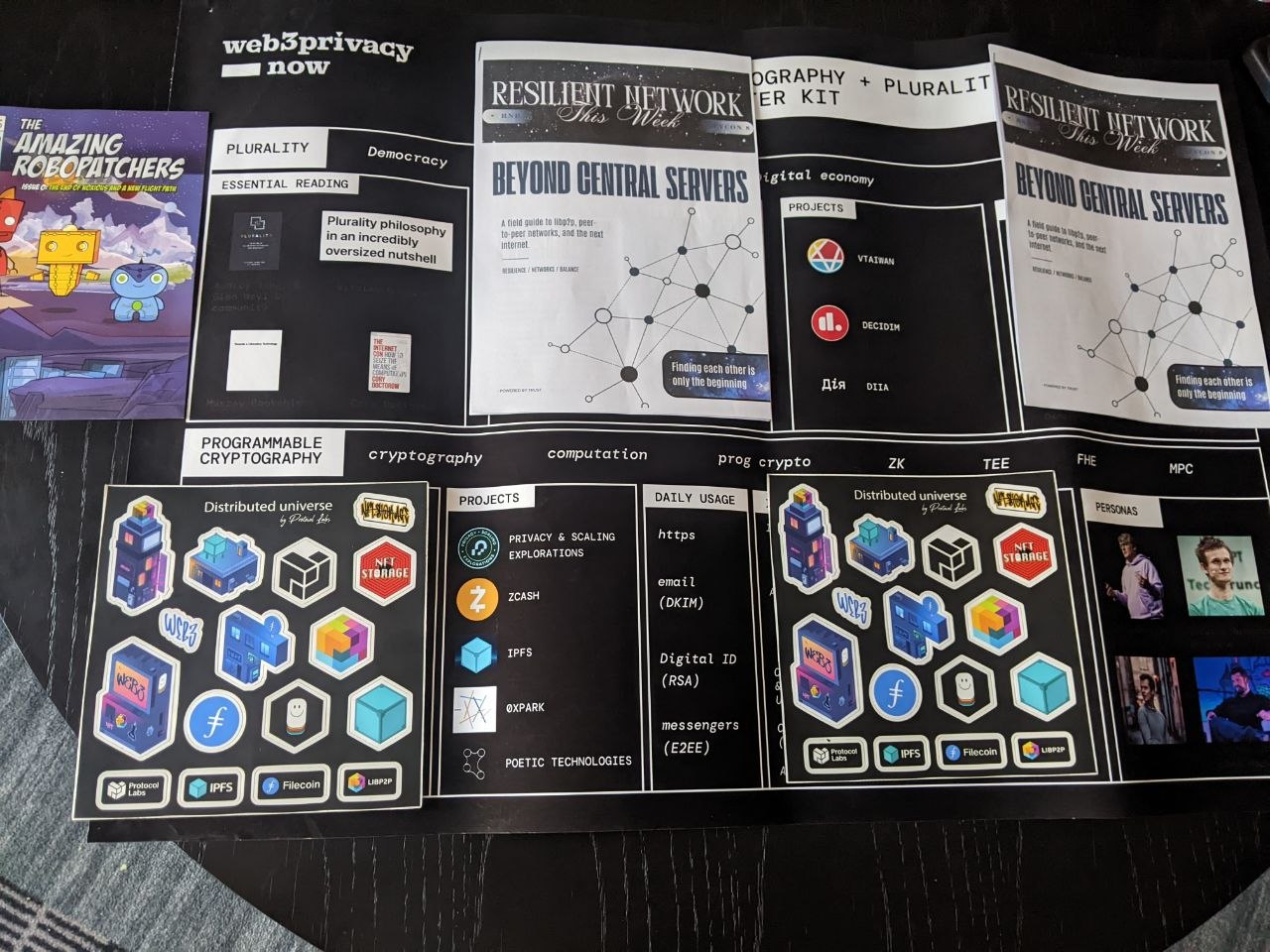
The Ethereum Cypherpunk Congress provided an opportunity to connect research and engineering with the broader principles of the cypherpunk movement.
Privacy is not simply a feature to be added to an application. It is a property that must be protected throughout the entire technology stack.
Encryption alone does not eliminate side-channel leakage. Decentralization alone does not guarantee censorship resistance. Cryptographic security today does not automatically guarantee resilience against tomorrow's threats.
The infrastructure beneath decentralized applications matters just as much as the applications themselves.
For libp2p maintainers and community members attending the Congress, these conversations reinforced the importance of building open, interoperable and resilient networking infrastructure.
The broader Mumbai Ethereum week, including Devcon 8 and the Resilient Networking Hub, continued these discussions through workshops, technical presentations and collaboration across the Ethereum and decentralized infrastructure ecosystems.
From privacy-preserving connectivity and observability to post-quantum networking, GossipSub, IPFS and formally verified protocols, the common theme was clear: decentralized infrastructure must be designed to withstand both existing and emerging security challenges.
6. Building What Comes Next
The cypherpunk vision has always been about enabling individual autonomy, resisting censorship, protecting privacy and building systems that do not require blind trust in centralized intermediaries.
Realising that vision requires practical engineering.
It requires tools that can discover hidden information leaks before attackers exploit them. It requires networking protocols that can adapt to future cryptographic threats. And it requires stronger ways to reason about the correctness and interoperability of distributed systems.
LeakDetectAI, the incremental path to quantum-resistant Ethereum and Leanp2p represent complementary contributions to this effort.
Privacy must be measurable. Cryptographic security must be adaptable. Networking must be resilient. Protocol behaviour must be verifiable.
These are important foundations for the next generation of Ethereum and the decentralized web.
The work continues with the open-source communities, researchers, protocol maintainers and ecosystem developers building these foundations together.
Explore the projects and resources
LeakDetectAI
Post-Quantum Ethereum
Leanp2p
Ethereum Cypherpunk Congress #3
With contributions and participation from libp2p maintainers and community members at Ethereum Cypherpunk Congress #3, Mumbai, November 2, 2026.