
// Security research
Securing the Network Beneath DeFi: libp2p Security Research at DeFi Security Summit 2026
· Courtyard by Marriott, Mumbai, India
November 1–2, 2026 · Courtyard by Marriott, Mumbai, India
DeFi security extends far beyond smart contracts. The peer-to-peer networking protocols, consensus clients, transport layers, and distributed infrastructure connecting blockchain ecosystems are equally critical to the security and resilience of decentralized finance.
At DeFi Security Summit 2026, held at the Courtyard by Marriott in Mumbai on November 1–2, we had the opportunity to bring this perspective to the security community through two technical presentations by Manu Gupta and Sumanjeet, representing the libp2p and py-libp2p ecosystems.
The presentations explored two important dimensions of peer-to-peer infrastructure security: discovering and mitigating vulnerabilities in consensus-critical networking implementations, and ensuring consistent authentication and identity verification across interoperable implementations.
Together, they demonstrated why network-layer security deserves the same attention as smart contract and application-layer security.
1. What a libp2p Gossipsub Crash Taught Us About AI Security and DeFi Infrastructure
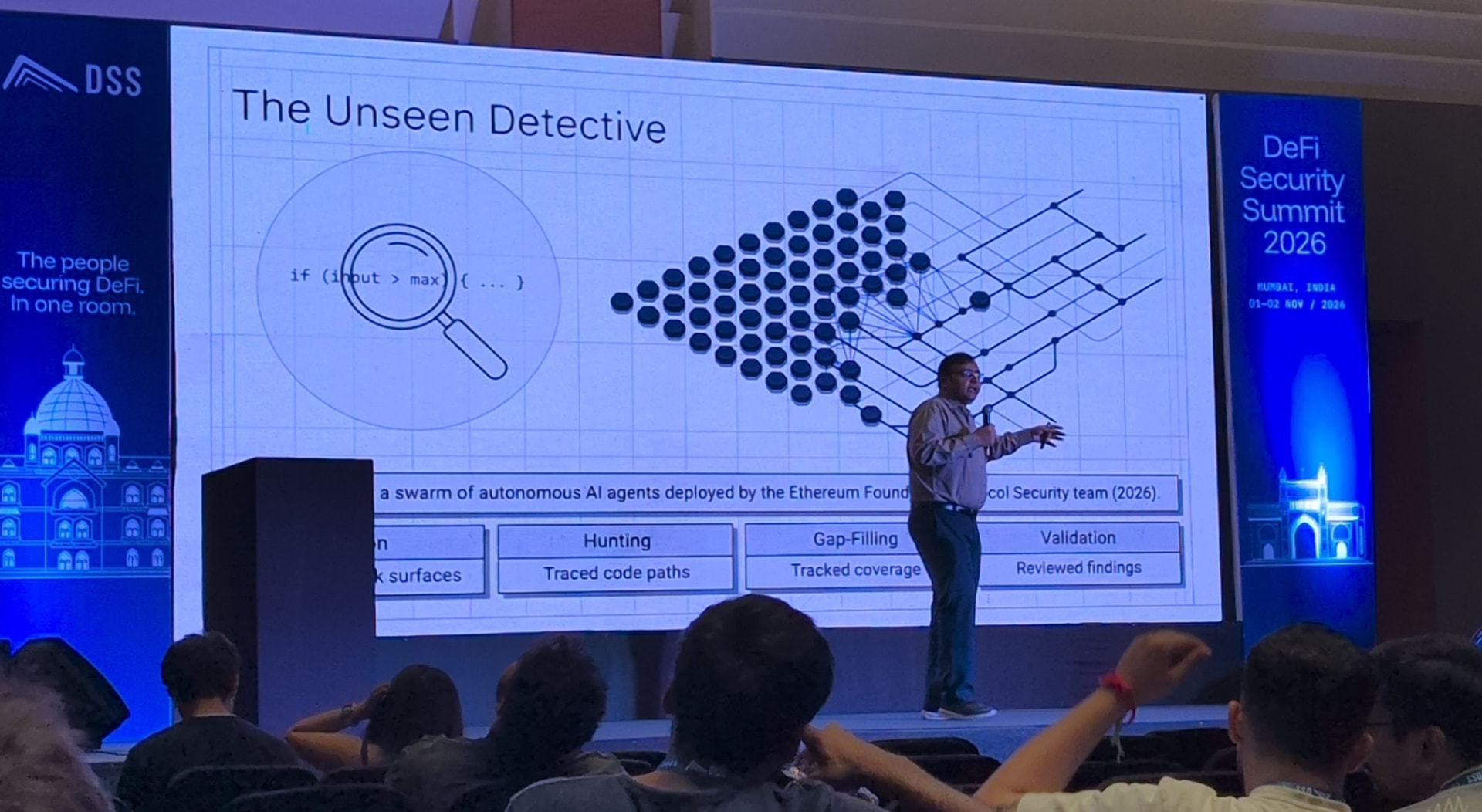
Speaker: Manu Sheel Gupta
Technical Lead and Maintainer – libp2p, IPLD and Multiformats
Watch the presentation: https://youtu.be/o2syYDTNAAc
Slide deck: https://drive.google.com/drive/folders/1JkjBzfneXQrCwLcw2_5OeuYzc0Oqp1X_
The first presentation explored CVE-2026-34219, an unchecked arithmetic overflow vulnerability in the Rust libp2p Gossipsub implementation.
The vulnerability demonstrated how a malicious network message could trigger a panic in a consensus client's networking process, potentially terminating the validator process and disrupting the node's participation in network consensus.
This is an important security consideration for DeFi infrastructure: a vulnerability in the networking layer can have consequences far beyond the networking stack itself. When consensus clients become unavailable, the resulting disruption can affect blockchain availability, validator participation, transaction processing, and ultimately the applications and financial systems depending on that infrastructure.
AI-assisted vulnerability discovery
An especially interesting aspect of this case was how the vulnerability was discovered through an AI agent swarm.
The presentation walked through the discovery process, demonstrating how multiple AI agents can contribute to security research, explore attack surfaces, identify potentially exploitable conditions, and generate vulnerability reports.
However, identifying a potential vulnerability is only the beginning.
A critical part of the discussion focused on how to evaluate and triage AI-generated security findings alongside established techniques such as traditional fuzzing, reproduction, code analysis, and validation of exploitability.
The goal is not to replace conventional security engineering with AI, but to combine the strengths of both approaches:
- AI agent swarms for exploring complex codebases and identifying potential vulnerability patterns.
- Traditional fuzzing and testing for reproducing unexpected behavior.
- Manual security review for validating root causes, attack scenarios, and practical impact.
- Responsible vulnerability triage and remediation to ensure that findings translate into meaningful security improvements.
The case study illustrated how AI-assisted security research can help uncover vulnerabilities in foundational infrastructure while reinforcing the importance of rigorous human validation.
Why this matters for DeFi
The presentation highlighted a broader lesson: DeFi security cannot be isolated from the infrastructure that keeps blockchain networks connected.
A consensus client is only as resilient as the networking components it depends on. Securing Gossipsub, transport protocols, peer discovery, and other networking primitives is therefore an essential part of protecting decentralized financial systems.
2. Security Audit of the py-libp2p Peer-to-Peer Networking Stack
Speaker: Sumanjeet
Maintainer – py-libp2p and unified-testing
Watch the presentation: https://www.youtube.com/watch?v=fKQ8FUnrCaU
The second presentation focused on security auditing the Python implementation of libp2p, py-libp2p, with particular attention to authentication, certificate verification, peer identity, and routing integrity.
The audit uncovered a recurring security issue across three areas of the implementation: remote certificates and signed peer identities were not being fully verified.
Three security issues in focus
1. QUIC transport – Certificate verification
The QUIC module accepted connections without enforcing proper certificate verification, creating an opportunity for unauthenticated or improperly authenticated peers to establish connections.
2. TLS transport – Authentication enforcement
The TLS module exhibited a similar issue, where connections could be accepted without the required certificate checks being properly enforced.
3. PeerRecords – Routing table integrity
The audit also identified a vulnerability involving unverified PeerRecords. Without adequate verification, malicious or improperly authenticated records could potentially poison a node's routing table.
These findings highlighted an important security principle: establishing a connection is not equivalent to establishing trust.
Peer identities, certificates, signed records, and routing information must all be validated before they are relied upon.
Interoperability must include security guarantees
One of the broader takeaways from the presentation was that interoperability is not simply about different implementations successfully communicating with one another.
They must also enforce consistent security expectations.
An implementation that successfully exchanges messages but applies weaker authentication or verification checks introduces risks across the wider peer-to-peer ecosystem.
The presentation discussed the fixes merged into py-libp2p, addressing the identified verification gaps and strengthening the implementation's security posture.
This work is particularly important as Python-based peer-to-peer applications increasingly participate in decentralized infrastructure, developer tooling, research environments, and blockchain ecosystems.
3. A Shared Mission: Building More Resilient Decentralized Infrastructure
Although the two presentations approached security from different directions, they reinforced a common message.
The security of decentralized applications depends on the security of the networks and protocols beneath them.
The Rust libp2p Gossipsub vulnerability demonstrated how a malicious message could affect consensus-critical infrastructure. The py-libp2p audit demonstrated how incomplete authentication and identity verification could undermine trust between peers and compromise routing integrity.
Together, these cases highlighted several priorities for the broader ecosystem:
- Protocol security: Strengthening foundational networking protocols and their implementations.
- Consensus resilience: Preventing network-layer vulnerabilities from disrupting validators and consensus clients.
- AI-assisted security research: Using agent swarms to expand vulnerability discovery while retaining rigorous validation and traditional testing.
- Consistent authentication: Ensuring that certificates, peer identities, and signed records are properly verified.
- Cross-implementation security: Making sure interoperability does not come at the expense of security guarantees.
- Open-source security collaboration: Sharing findings, fixes, and testing methodologies across implementations and dependent projects.
4. Continuing the Conversation
DeFi Security Summit 2026 provided an excellent opportunity to connect with security researchers, protocol engineers, auditors, and builders working on the next generation of decentralized infrastructure.
We were glad to contribute perspectives from the libp2p and py-libp2p ecosystems and share practical lessons from vulnerability discovery, security auditing, and remediation.
A special thanks to the DeFi Security Summit organizers and everyone who joined the discussions, shared feedback, and continues to work toward safer decentralized infrastructure.
The response to Manu's presentation was particularly encouraging. Latest in Cyber highlighted the talk, commenting:
"i is nerd-ing Loved this talk by Manu about AI Security v trad fuzzing"
Feedback: https://x.com/latestincyber/status/2116850973045924256
Watch both presentations:
- [What a libp2p Gossipsub Crash Taught Us About AI Security and DeFi Infrastructure – Manu Gupta](https://youtu.be/o2syYDTNAAc)
- [Security Audit of the py-libp2p Peer-to-Peer Networking Stack – Sumanjeet](https://www.youtube.com/watch?v=fKQ8FUnrCaU)
Learn more about [DeFi Security Summit](https://defisecuritysummit.org).
Building secure, interoperable, privacy-preserving, and resilient peer-to-peer infrastructure is foundational to the future of decentralized finance.